9•Article
Climate Change Overview: Impacts, Mitigation, and Adaptation in Iraq
KAPITA’s Research TeamSeptember 24, 20258 min read
Article Summary
A comprehensive study of Iraq’s climate crisis: desertification, water scarcity, declining rainfall, record heatwaves, dust storms, salinization, and energy stress. The report reviews Iraq’s Paris Agreement commitments (NDCs), covering energy, agriculture, waste, housing, and industry. It also profiles green startups (KESK, Tanweer, Mosul Solar, Eco Life). Recommendations include desertification control, greenbelts, wastewater reuse, and regional water negotiations.
Report Summary
KAPITA’s Research Team
Climate Change Overview: Impacts, Mitigation, and Adaptation in Iraq
In recent years, global climate change has become an established truth that cannot be argued against any longer. Iraq, in particular, is experiencing the full spectrum of climate change's effects, all the more so given the country's fragile state and dilapidated infrastructure.
What was formerly regarded as the Middle East's breadbasket and part of the Fertile Crescent, Iraq, has long since departed from that standard. Across the nation, climate change is increasing temperatures, decreasing rainfall, accelerating desertification, causing intense sand storms, depleting water resources, weakening agriculture, and wreaking havoc on the economy. Iraq's 42 million people are concentrated in a few locations within the country due to the harsh climate. These conditions have led to a direct impact on the lives of the people and their economic, water, and food security.
Geography and Climate
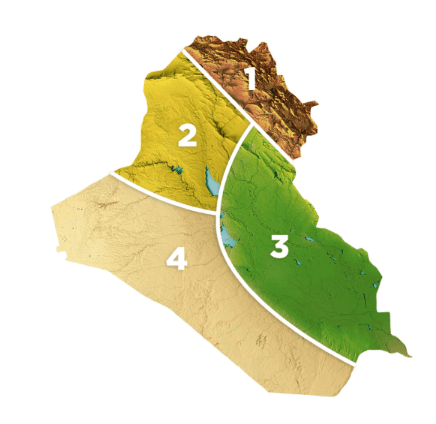
Located in southwest Asia, the Republic of Iraq is bounded on the north by Turkey; on the east by Iran; on the west by Jordan and Syria; and on the south by Saudi Arabia and Kuwait. Topographically, the country is divided into four geographical regions: mountains to the north and northeast (1); a northern upland region between the Tigris and Euphrates rivers (2); central and southeastern Iraq's Tigris-Euphrates alluvial lowlands (3); and the desert to the west and south (4).
Iraq has a predominantly continental and subtropical semi-arid climate, with the exception of the northern and northeastern mountainous regions, which have a Mediterranean climate. Summer
and winter, with brief transitional times in between, are the two major seasons in the country with noteworthy weather conditions. Summer, which lasts from late April to October, is defined by clear skies, exceptionally high temperatures, low relative humidity, and no precipitation. During the season, temperatures range between 35 and 51 degrees Celsius throughout the country. Winters, on the other hand, are mild to cold. They last from November to March and can be anywhere between 2 and 15 degrees Celsius. Rainfall in Iraq is seasonal, falling largely between December and February for the bulk of the country, except for the north and northeast regions, where the rainy season lasts from November to early April.
Major Climate Change Issues in Iraq
Desertification
The desertification of Iraq is caused by a range of factors. Climate elements contributing to the problem include, but are not limited to, high temperatures, water scarcity, and erosion of soil. The issue is further exacerbated by human-induced factors such as population growth, which increases the depletion of natural resources; unregulated tree felling plays a major role in deforestation, poor water management, and inefficient farming practices. The sum of these variables has brought the country to the brink of agricultural collapse. According to the Ministry of Agriculture, the agriculture sector is declining, with an annual loss of 100 square kilometers of arable land due to desertification, and more than 40% of the country is already a desert. Between 1970 and 2010, estimated cultivated lands decreased from 12.2% to 8.3% of the country's total area.
Water Scarcity and Drought
A shortage in water supply and water security in general is an imminent problem that is facing
the entire human population worldwide. Iraq, in specific, is no stranger to the re-occurrence of drought periods throughout its history. However, increased changes in the climate in terms of rising heat and significantly reduced rainfall are likely to result in a more frequent trend of those extreme events. Furthermore, the poor management of water resources, reduced volumes of water flowing into the Tigris and Euphrates rivers from the origin countries, increased population demand, inefficient water consumption in the oil and agriculture sectors, and conflicts all contribute to the water insecurity which threatens at least 7 million of the total Iraqi population. Comprising 98% of Iraq’s water supply, the Euphrates and Tigris rivers have lost 30% of their flow in reference to the 1980s, and it is further projected to decline to 50% by 2030, according to T. von Lossow. According to UNICEF, the 2020–2021 rainfall season was the second driest in the last 40 years, causing a reduction in water flow in Tigris and Euphrates by 29% and 73%, respectively.
Declining Precipitation
The winter season of 2020–2021 has been marked as the second-lowest record in four decades by below-average rainfall, notably in Iraq's northern governorates, according to the WFP. Such weather prevailed throughout the country from November 2020 to January 2021. Between February and April 2021, precipitation was at above-average levels in the country's central regions, particularly the Diyala and Wasit governorates
According to FAO, the northern regions of the country, on the other hand, experienced below-normal precipitation, especially in the governorates of Nineveh, Duhok, and Erbil. This was detrimental to their communities since they rely significantly on rainwater to cultivate agriculture.
Reflecting these tendencies, the seasonal overview from November 2020 to April 2021 shows rainfall below normal in the country's northern regions; Nineveh, Duhok, western Erbil, western Kirkuk, and northern Salah al-Din. Precipitation was up to 40% below average. This has almost certainly resulted in decreased planted area, crop failures, and a damaging effect on the production of wheat and barley, the two major rainfed winter crops. Estimates show a decline of 70% in the production of wheat, while barley cultivation is almost completely diminished in Nineveh.
Extremely High Temperatures
In recent years, the temperature is either breaking records or coming very close to it, as the temperature soars above 50°C. Basra province, in 2016, broke the record for the hottest temperature in Iraq with 53.8°C. In 2020, Baghdad experienced a 51.8°C breaking its former highest temperature record of 51°C set in 2015, according to the Weather Network. This is in line with the fact that 2016 and 2020 are the warmest years recorded globally according to NASA. What is more important than records is the prevalent long-term warming trend with an increasing frequency of extreme temperatures that is becoming routine. Unless global emissions are reduced, the Middle East, including Iraq, is set to experience 121 days per year of extreme heat by the end of the century, making certain areas in Iraq uninhabitable, which reveals the great threat heat is imposing on existence within the country.
Dust and Sand Storms
Lately, Iraq has been experiencing an alarming increase in the number of sandstorms as of late. This is attributable to dramatic swings in annual rainfall, increasing temperatures, poor water management, and the abandonment of agricultural fields. These dust storms can pose all sorts of threats to human health, transportation, and agriculture, as well as the country's economy. In 2022, the surge of prolonged dust storms in Iraq led to a variety of complications. Numerous hospitalization cases were recorded throughout the country as a result of dust-induced respiratory illnesses. The airports of Baghdad, Erbil, Sulaimani, and Najaf temporarily halted all flights during April due to poor visibility, which poses a danger when aircrafts land and take off.
Soil Erosion and Salinization
During the last two decades, soil degradation and salinization have been causing substantial damage to agriculture. Reportedly, 5% of used areas are lost annually to salinization and waterlogging. Of the 3.5 million hectares of irrigation-fed land, about 1.5 million hectares are in the range of permissible salt content, whereas high saline has stopped 0.5 million hectares from being utilized by farmers. This impact of salinization is currently causing a US$ 300 million loss each year. The production drop has been reported to be from 40% to 60% due to salinity. Hence, a reduction in salt content could double cultivated land in irrigation projects’ areas, which is reported to be only 30%, possibly increasing crop yield by US$ 3.2 billion per year, according to the WFP.
Increased Energy Consumption
The gap between supply and demand, and the common power cuts in peak summer months, which show the inefficiency in transmission and distribution, have given rise to small-scale power generators known as neighborhood generators. The need in heated summers for those privately owned generators costs Iraqis about 60-120 USD/kWh. In just 2018, the total charge was a rigorous US$ 4 billion, the same as the allocation for the Ministry of Electricity in the government budget.
Nationally Determined Contributions of Iraq (NDC)
Ratifying the Paris Agreement in 2021, Iraq submitted its first NDC in October, in which it aspires to implement its nationally determined contributions for the period from 2021 to 2030 with the goal of an expected reduction of 1–2% of its total greenhouse gas emissions by national effort, and up to 15% when international financial and technical support is granted (Iraqi NDC, 2021).
Based on Iraq's Nationally Determined Contributions (NDC), the ensuing sectors have been identified as critical components for the country's mitigation strategies to effectively achieve its set target:
● Energy Sector
As this sector generates the largest rate of greenhouse gas emissions, accounting for 75% of Iraq's total emissions, the government has taken a staunch stance towards implementing measures to effect change. These measures include a reduction in gas flaring, the adoption of renewable energy technologies, and a gradual shift towards hybrid and eco-friendly automobiles.
● Industrial Sector
The Ministry of Industry and Mineral Resources aims to reform this sector by developing and rehabilitating industrial processes in ongoing projects, introducing low-carbon technologies, commencing recycling projects, and supporting the private industrial sector in the field of emissions reduction to develop environmentally friendly industrial technologies.
● Agricultural Sector
The Iraqi government aims to reform the agricultural sector by implementing various measures, including controlling the cultivation of crops that generate large quantities of methane, such as rice, and limiting their water consumption. The government also seeks to utilize renewable energy technologies like solar and wind energy to power irrigation pumps, raise awareness of climate-smart agriculture, improve nitrogen fertilizer application techniques to reduce N2O emissions and promote no-tillage farming to reduce emissions from agricultural machinery use, as effectively implemented in the Kurdistan Region.
● Waste Sector
In an effort to diversify its economic sources, Iraq has set its sights on localizing green investment in waste management. To achieve this, the country plans to adopt a solid waste management law that promotes recycling, waste conversion to energy, and the elimination of garbage burning. Additionally, Iraq plans to employ plasma technology to generate electricity from waste and implement an integrated waste management system.
● Housing Sector
Iraq's housing sector is committed to adopting eco-friendly principles that aim to rationalize electrical energy use and transition to low-emission pathways. This objective is based on the promotion of renewable energy use throughout the country. The proposed strategies to achieve this goal include the adoption of energy-saving lighting technology, the issuance of green building codes, and the utilization of modern technologies for thermal insulation, lighting, and sustainable cities.
Green and Cleantech Startups
Green Gold is a youth initiative that attempts to reduce organic waste through recycling and conversion into organic fertilizers of superior quality and competitive pricing.
KESK was established to alleviate Iraq's energy crisis by providing a variety of green solutions such as solar power technologies, energy efficiency analysis, and sustainable construction consultancy services.
Tanweer Energy Solutions is a company that was founded in 2019, it provides energy-efficient electrical grids, smart building utilities, solar panels, and UPS backup systems for commercial and industrial projects.
Ecopotamia is an online store founded to provide the community with eco-friendly, sustainable, plastic-free products. With products such as bamboo toothbrushes and reusable cotton face masks, Ecopotamia aims at combating climate change by reducing daily waste and encouraging mindful consumption.
Eco Life provides plastic alternative products to promote sustainability and climate change awareness. Additionally, Eco Life utilizes Iraqi resources to encourage locally manufactured products, such as their signature drinking straws made of cane harvested from Diyala marshlands.
Green Shaov provides agricultural development services by applying artificial intelligence principles to enhance productivity and a variety of crops. Services include consultation by agricultural engineers, smart management of greenhouses, soil moisture control through smart irrigation systems that promote efficient water use, soil quality and adaptation management through technology-based soil meters, in addition to other services.
Mosul Solar was inspired in 2020 by the prolonged power cuts of up to 22 hours a day in Mosul. To help mitigate the electricity problem with a cheaper, more reliable, and environmentally clean power source, the business provides and installs solar cells for all kinds of residential and commercial units.
Ecomena focuses on tackling environmental pollution through waste management. Aiming to reduce waste, the startup recycles plastic into eco-friendly, durable plastic materials that have residential, commercial, and structural applications.
Recommendations
A series of actions needs to be taken into consideration so as to help mitigate the growing effects of climate change, those are outlined as follows:
● Desertification prevention and reversal require significant policy initiatives and managerial
strategies from the government.
● Foster a climate-conscious culture among the public in order to promote eco-friendly behaviors
such as mindful water consumption, recycling, less reliance on plastic products, and reduced
littering.
● Maintain vegetative covers and hasten the implementation of greenbelt projects to prevent
further soil erosion and degradation.
● Assist farmers in desertification-prone areas by providing them with the necessary supplies they
require to avoid rural migration.
● Push negotiations with Turkey and Iran, the riparian countries on the Tigris and Euphrates rivers as well as their tributaries, to acknowledge Iraq's rights to its shared waters and to enhance regional cooperation in pursuit of water and climate security.
● Establish an oasis in deserts and arid areas with the goal of mitigating the effects of climate change on biodiversity.
● Build wastewater treatment systems in villages and rural communities to provide
irrigation-quality water, as well as mobile organic waste treatment plants to generate biogas and organic fertilizer on-site.
Article Information
Details
- Author:KAPITA’s Research Team
- Published:September 24, 2025
- Issue:9
- Read Time:8 min
Need Custom Analysis?
Contact our research team to discuss your specific business landscape analysis needs.
Contact UsMore from 9