Publication•April 16, 2023
free
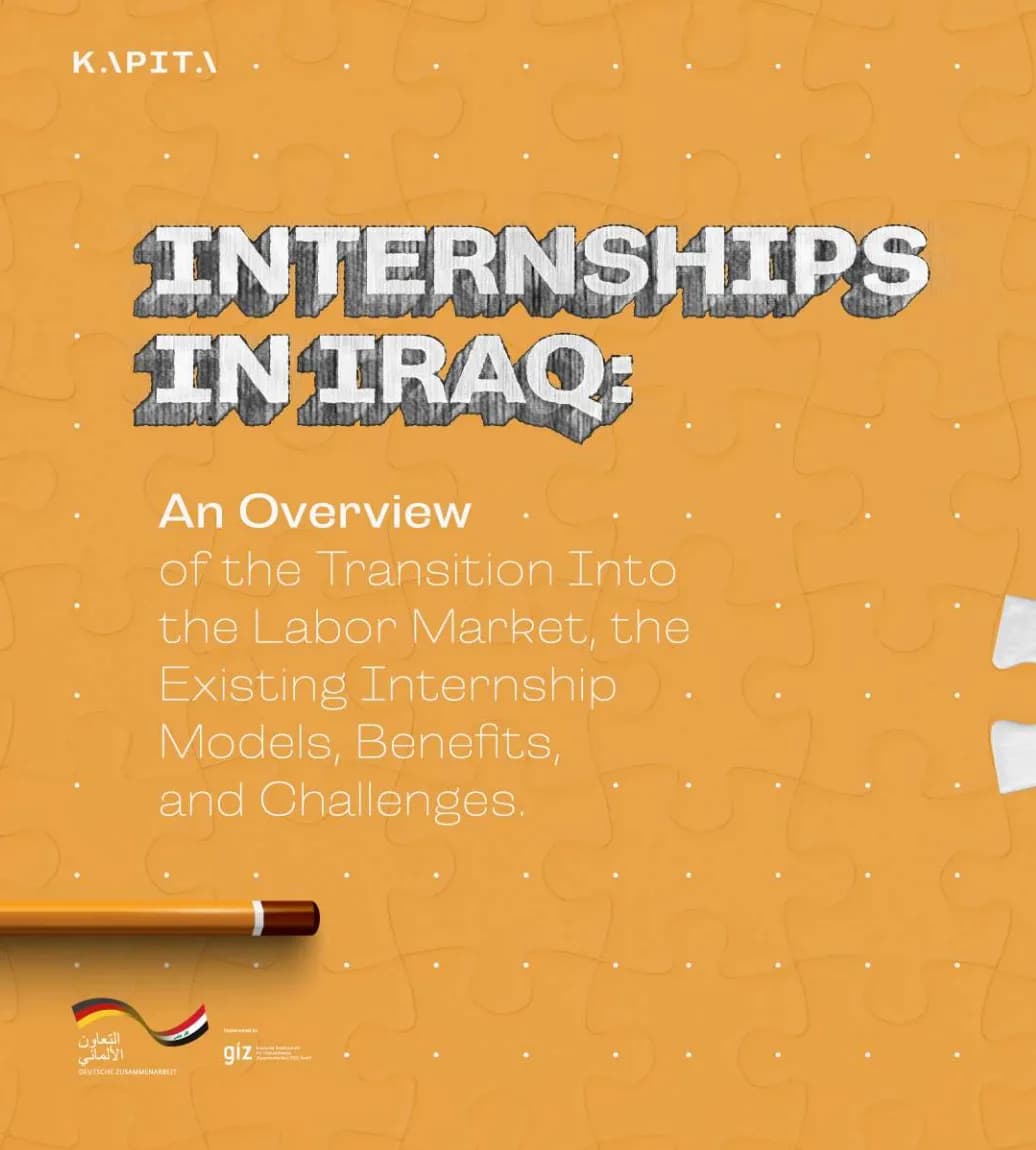
Internships in Iraq: An Overview of the Transition Into the Labor Market, the Existing Internship Models, Benefits, and Challenges
#Labor Market Iraq#Internships Iraq#Higher Education Iraq#Skills Gap Iraq#Market Research Iraq
April 16, 2023Kapita Research Team
This report provides labor market research insights into internships in Iraq, examining the transition from higher education to employment and the role of internships in addressing skills gaps. It analyzes existing internship models across the public and private sectors, evaluates their benefits and challenges, and assesses their impact on employability. The report concludes with expert-informed recommendations to improve internship frameworks and strengthen labor market integration in Iraq.
Publication Overview
April 16, 2023
This report provides labor market research insights into internships in Iraq, examining the transition from higher education to employment and the role of internships in addressing skills gaps. It analyzes existing internship models across the public and private sectors, evaluates their benefits and challenges, and assesses their impact on employability. The report concludes with expert-informed recommendations to improve internship frameworks and strengthen labor market integration in Iraq.
Full Content
Executive Summary
This report examines the role of internships in facilitating the transition from higher education to the labor market in Iraq. It assesses how existing internship models contribute to skills development, employability, and workforce readiness, while highlighting structural challenges within the education system and labor market that limit their effectiveness.
To achieve that goal, it will explore the state of the higher education system in Iraq in terms of historical background and the way it shapes students’ perspectives on development and employment. This report highlights the root causes of the skill gap in the Iraqi labor market and identifies key learning methods as alternatives to the education system. Halfway through, it digs deeper into the existing internships and their role in creating a smoother transition into the Iraqi labor market and vice versa: a comprehensive analysis and description of the current internship models in the public and private sectors. This report concludes with meaningful recommendations based on our research and insights from experts in their respective fields, aiming at improving the current state of internship models. This report’s key findings and discussion points are as follows:
• The education system aimed at fundamental development on the scientific and social level, yet decades of instability, sanctions, and conflict caused the education system, especially higher education, to decline as it was isolated from technological and intellectual development. A national strategy was aimed at rebuilding the higher education system. As of today, there are 70 private universities and 35 public universities in the Federal Government. As for KRG, there are 35 universities, 18 universities of which are public. Among the programs that The Ministry of Higher Education and Scientific Research has worked on were accreditation and quality assurance.
• The tendency towards public sector employment is still the dominant notion among university graduates who grow in numbers every year. In 2018 - 2019, the number reached up to 152,444 graduates, who ultimately become job seekers. Iraqi graduates favor public sector employment over the private sector, which is an overall Iraqi cultural tendency. The fact that public employment comes with an array of benefits, such as job security and retirement pension, is more appealing to graduates and, therefore, what drives them to seek it over employment in the private sector.
• A turbulent transition is largely a product of a lack of skillsets and a poorly functioning education system. The higher education system is performing inadequately due to the fact that the theory-based curricula are outdated, and the method of teaching encourages memorization rather than critical thinking. The majority of the graduates entering the labor force lack the necessary skills and tools that qualify them to navigate their way professionally into the labor market.
• The Iraqi labor force suffers significantly from the absence of a wide range of soft skills and technical skills. Based on research, the majority of Iraqi graduates have a limited understanding of soft skills and how to develop them, professional workplace attitude, leadership, and communication. The skill deficiency is also noticeable across IT, the English language, and other advanced skills. As education fails to fulfill its learning objectives, graduates now as Executive Summary 7 the workforce seek other alternatives, such as self-learning, training, and the workplace, to achieve a certain level of experience and knowledge and gain the necessary skills.
• The Iraqi internship landscape has witnessed remarkable training models over the past years. Companies, NGOs, and international agencies have taken part to revolutionize the internship situation in Iraq. The goal is to create new and better training models that emphasize experience over theory. Therefore, sev - eral effective training programs have been dedicated to creating a skilled work - force and culturally fit employees. These programs are designed to deliver soft and hard skills as well as business-related skills.
• The optimal model of an internship structure is based on matching the needs of the company’s commercial objectives and the intern’s learning gains, incentives, and rewards. Education development experts and business leaders emphasize the effectiveness of this training model because a company that needs to pro - mote its products or services would consider the ambassador model that offers interns marketing and sales training. This allows companies to achieve their commercial needs through interns by providing the relevant training.
• Several challenges are preventing a well-defined internship model in Iraq. Education institutions and the private sector lack the finances to support and maintain internship programs, as a 2022 report shows that 44% of surveyed companies consider budgetary restrictions the main barrier to implementation. The role of CDCs across Iraqi universities is significantly inadequate. Another challenge is the failure to highlight the internship’s role and the success stories of those taking it. Outsourcing of skills has negatively contributed to the proper internship implementation because they abolish the need for local skills devel - opment.
• This report lists objective recommendations that can improve the state of in - ternships in Iraq. Internships should have practice-based training and financial benefits to incentivize interns. There should be an effective communication system between the private sector and universities, which includes the actual participation of CDCs, in order to facilitate access to such opportunities.
Publication Information
Publication Details
Author:Kapita Research Team
Published:April 16, 2023
Category:report
Documents:1 PDF
Tags:5
Academic Metadata
Suggested Citation
Kapita Research Team. (2023). Internships in Iraq: An Overview of the Transition Into the Labor Market, the Existing Internship Models, Benefits, and Challenges. Kapita Research.
Need Custom Research?
Contact our research team to discuss your specific research needs and objectives. We provide tailored analysis for your business.
Contact Research TeamWork with Kapita Research
Need this level of insight for your own decision?
This report is a sample of what our team produces. We run custom market research, sector deep-dives, competitor mapping, and market-entry studies for businesses and investors operating in Iraq. Tell us what you're trying to figure out — the first consultation is free.
Related Publications