Publication•April 6, 2023
free
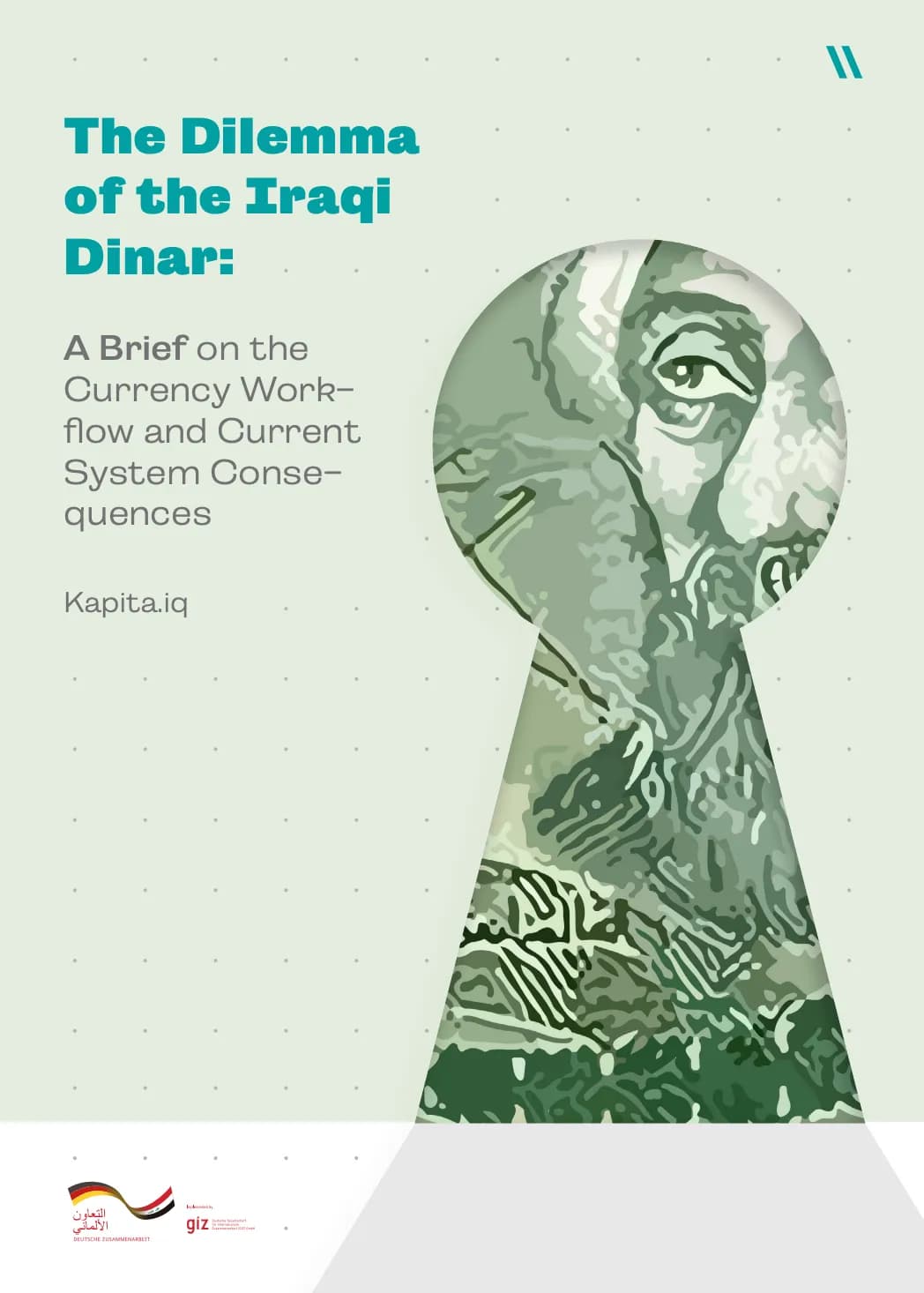
The Dilemma of the Iraqi Dinar: A Brief on the Currency Workflow and Current System Consequences
#Iraqi Dinar#Currency Policy Iraq#Banking System Iraq#Economic Stability Iraq#Market Research Iraq
April 6, 2023Kapita Research Team
This brief provides economic research insights into the Iraqi dinar–U.S. dollar crisis, examining the structure of Iraq’s currency system, banking framework, exchange rate mechanisms, and dollar value chain. It analyzes inflationary pressures, recent financial disruptions, and money transfer methods, highlighting their implications for economic and social stability in Iraq.
Publication Overview
April 6, 2023
This brief provides economic research insights into the Iraqi dinar–U.S. dollar crisis, examining the structure of Iraq’s currency system, banking framework, exchange rate mechanisms, and dollar value chain. It analyzes inflationary pressures, recent financial disruptions, and money transfer methods, highlighting their implications for economic and social stability in Iraq.
Full Content
Executive Summary
This brief examines the structure and functioning of Iraq’s currency system, focusing on the Iraqi dinar–U.S. dollar relationship and its economic consequences. It analyzes the historical evolution of the banking system, the dollar value chain, exchange rate dynamics, inflationary pressures, and recent policy responses, providing context for understanding the current dollar/dinar crisis and its broader implications for economic stability in Iraq.
• Early banking system: It began during the 1930s, with the establishment of the Iraqi Currency Board, which laid the seed for the Iraqi banking system and officially marked the Iraqi currency. Up until 2003, seven of the primary banks were established including the Central Bank of Iraq (CBI). The Iraqi banknote witnessed multiple changes over the years alongside the value associated. The CBI switched the Iraqi dinar peg from the British pound to the U.S. dollar with a 1 dinar per 2.8 dollars during the 1950s.
• Dollar value chain: Dollar generation begins with the Iraq Ministry of Oil being responsible for oil operations and extraction as well as licensing round productions within the country except for the Kurdistan Region, as oil accounts for around 99% of Iraqi exports. Marketing and selling activities fall under the authority of the State Oil Marketing Organization (SOMO). Since Iraq does not receive oil proceeds directly, they get deposited into the Development Fund for Iraq (DFI), which is managed by the Federal Reserve Bank of New York. Funds in the DFI get transferred to the Ministry of Finance’s account at the Central Banks of Iraq. Subsequently, according to the Financial Management and Public Debt Law No. 95 of the year 2004, the Iraq federal budget is prepared. Similarly in KRG, the procedures follow a relatively familiar path.
• A tale of currencies: The CBI has the legal framework to sell the U.S. dollar to authorized banks and exchange companies and receives Iraqi dinar in return based on an exchange rate set by the CBI itself. The exchange rate has been changed twice over the last three years to maintain economic stability. Unlike the official exchange rate, the free market exchange rate is volatile with higher periodic spikes.
• Inflation and price level instability: There has been a significant jump in the annual inflation rate since 2020, as it went up from 0.6% in 2020 to 6% in 2021. This includes transportation, tobacco, health, food and non-alcoholic beverages, which have been hit the most as they increased by 15.9%, 13.6%, 12.2%, and 4,8%, respectively between 2020 and 2021. According to WFP’s CBT survey, the food basket average price increased by 6% month-on-month and by 10% year-on-year in December 2020. Similarly, by December 2021, prices got even higher.
• Recent crises and response initiatives: Recent Iraqi crises are overlapping. It is undeniable that dollar smuggling in a form of forged invoices has been dramatically eroding the Iraqi economy. Therefore, the CBI has built an electronic platform aiming at increasing transparency and eliminating illegal money transfers when buying from CBI’s window.
• Methods of money transfer: Money transfers can be done domestically and internationally through several channels. The hawala system is unofficial and does not require a banking system to be carried out. All the other methods require a certain level of official authorization.
Publication Information
Publication Details
Author:Kapita Research Team
Published:April 6, 2023
Category:report
Documents:1 PDF
Tags:5
Academic Metadata
Suggested Citation
Kapita Research Team. (2023). The Dilemma of the Iraqi Dinar: A Brief on the Currency Workflow and Current System Consequences. Kapita Research.
Need Custom Research?
Contact our research team to discuss your specific research needs and objectives. We provide tailored analysis for your business.
Contact Research TeamWork with Kapita Research
Need this level of insight for your own decision?
This report is a sample of what our team produces. We run custom market research, sector deep-dives, competitor mapping, and market-entry studies for businesses and investors operating in Iraq. Tell us what you're trying to figure out — the first consultation is free.
Related Publications