Publication•November 16, 2022
free
Iraqi Stock Market Overview: Analyzing Sectors and Market Performance
#Stock Market Iraq#Investment Landscape Iraq#Iraq Economy#Market Research Iraq
November 16, 2022Kapita Research Team
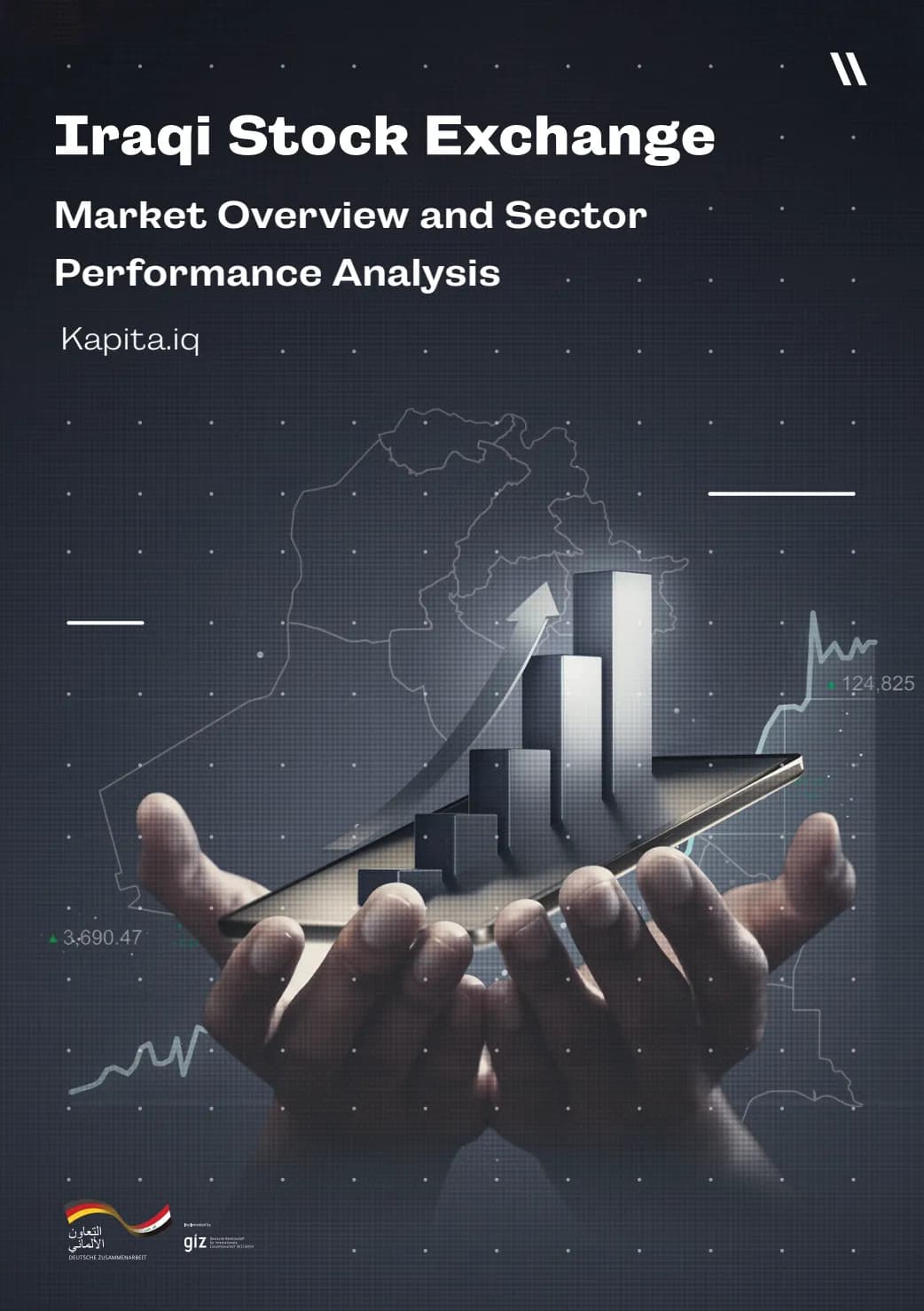
This report provides an in-depth analysis of the Iraqi Stock Exchange (ISX), examining its historical development, current market structure across nine sectors, and key performance indicators. It analyzes traded shares and volume, company and session activity, market capitalization, foreign investment, and compares ISX performance with regional stock exchanges, while highlighting structural challenges facing the market.
Publication Overview
November 16, 2022
This report provides an in-depth analysis of the Iraqi Stock Exchange (ISX), examining its historical development, current market structure across nine sectors, and key performance indicators. It analyzes traded shares and volume, company and session activity, market capitalization, foreign investment, and compares ISX performance with regional stock exchanges, while highlighting structural challenges facing the market.
Full Content
Executive Summary
The Iraqi Stock Exchange (ISX) has played an increasingly important role in Iraq’s financial system since its establishment in 2004. Designed to operate in line with international stock exchange standards, the ISX received technological support from NASDAQ in 2008 and 2019. Currently, the ISX hosts 105 listed companies trading across nine sectors, operating through approximately 225 trading sessions annually, and is a member of both the Federation of Euro-Asian Stock Exchanges (FEAS) and the Arab Federation of Capital Markets (AFCM).
In this report, we dive deep into the history of the stock exchange market in Iraq, its current status across sectors, the challenges faced, and a comparison to regional stock exchange markets.
Key results from our report include:
• Trading Shares and Volume. In the year 2021, traded shares and volume increased compared to the previous years, which were mainly offset by the COVID-19 pandemic.
• Companies and Sessions. Listed companies reached 105 in 2021, 76% of them were trading during the 226 trading sessions in the same year.
• Sectors in the ISX. Although there are 9 sectors listed in the ISX, the money transfer sector stopped trading almost completely after 2019. The telecommunications sector is the highlight of ISX, as AsiaCell had its IPO in 2013.
• Foreign Exchange in ISX. The Asiacell IPO doubled the ISX capitalization to $9.3bn, as foreign investors mobilized their foreign capital in Iraq.
• Regional Stock Exchanges versus ISX. The most comparable stock exchange market to the ISX is the Egyptian Stock Exchange. The ISX has 4 times the capitalization of the Egyptian Stock Exchange market with half the number of listed companies.
• Issues in ISX. The undeveloped market infrastructure, the lack of a unified policy to voluntarily disclose in Iraqi corporations, and the confusing tax regime are some of the issues facing the ISX.
Publication Information
Publication Details
Author:Kapita Research Team
Published:November 16, 2022
Category:report
Documents:1 PDF
Tags:4
Academic Metadata
Suggested Citation
Kapita Research. (Year). Iraqi Stock Market Overview: Analyzing Sectors and Market Performance. Kapita Research.
Need Custom Research?
Contact our research team to discuss your specific research needs and objectives. We provide tailored analysis for your business.
Contact Research TeamWork with Kapita Research
Need this level of insight for your own decision?
This report is a sample of what our team produces. We run custom market research, sector deep-dives, competitor mapping, and market-entry studies for businesses and investors operating in Iraq. Tell us what you're trying to figure out — the first consultation is free.
Related Publications