Publication•June 12, 2022
free
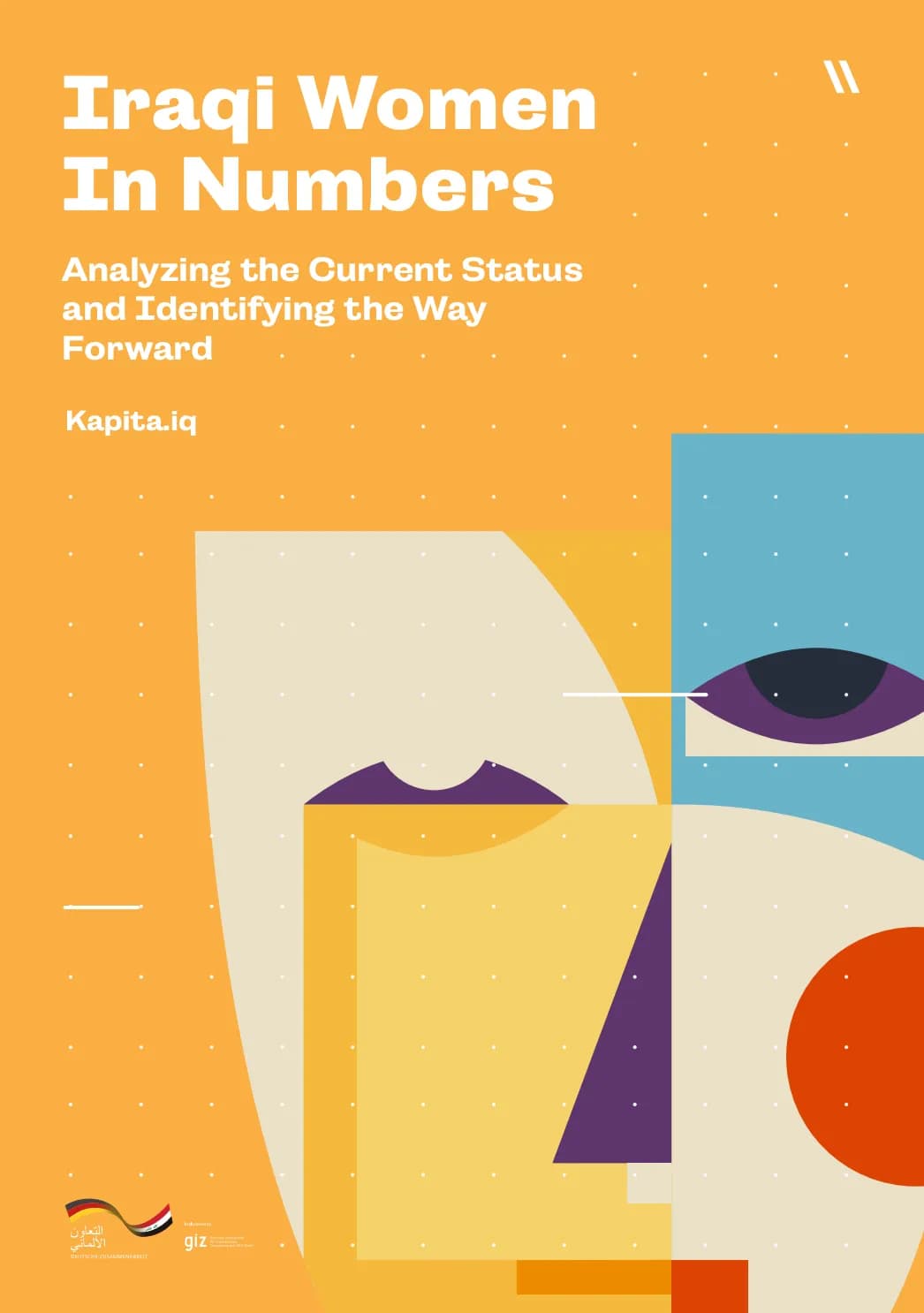
Iraqi Women in Numbers: Analyzing the Current Status and Identifying the Way Forward
#Women in Iraq#Gender Gap Iraq#Women Employment Iraq#Women Education Iraq#Market Research Iraq
June 12, 2022Kapita Research Team
This report provides a data-driven overview of the status of women in Iraq across demographics, education, labor force participation, entrepreneurship, ICT skills, and health. It highlights key gender gaps and structural challenges while offering evidence-based insights to inform policy, programs, and gender-inclusive development in Iraq.
Publication Overview
June 12, 2022
This report provides a data-driven overview of the status of women in Iraq across demographics, education, labor force participation, entrepreneurship, ICT skills, and health. It highlights key gender gaps and structural challenges while offering evidence-based insights to inform policy, programs, and gender-inclusive development in Iraq.
Full Content
Executive Summary
Women’s integration and full participation in society serve as a crucial part of the sustainable development of nations and are reflected in the economic growth of those nations. Iraqi women represent half of the country’s population.
However, this percentage is not reflected in the workforce participation nor in the equal access to resources and opportunities. According to the Global Gender Gap report, Iraq has ranked 154 out of 156 countries in the Global Gender Gap Index for 2021 with a score of 0.53 out of 1, a score of 0.228 out of 1 in the economic participation, and a score of 0.8 out of 1 in educational attainment.
This report provides an overview of Iraqi women’s status from all the different aspects of demographics, education, employment and entrepreneurship, ICT skills, and health. It aims to provide the necessary information and data to draw a comprehensive picture of where women stand today in the Iraqi context.
This report also highlights the main issues and challenges women encounter along the way in all different aforementioned aspects, as well as the clear gender disparities. This situational analysis of Iraqi women can serve as a tool to build on effective recommendations to redeem the gender gaps in the Iraqi ecosystem, mitigate the gender-specific challenges and limitations, and enable and empower women to claim their full potential and participate in the Iraqi society. This report’s key findings and discussion points are as follows:
• Youthful Female Population: women contribute to 49.48% of the Iraqi population, which amounts to half of the Iraqi society. Around 65.39% of women are under the age of 30, divided into 60.04% under the age of 15 and 39.96% are 15 and above.
• Educational Attainment:
Iraq has the lowest female literacy rate amongst its neighboring countries, with 79.9%, which is also below the global average of 83.3%. Moreover, the enrollment rate of girls is 48.63% in primary education and 47.48% in secondary education out of the total enrollment rate in the aforementioned education levels, respectively.
Iraq has the lowest female literacy rate amongst its neighboring countries, with 79.9%, which is also below the global average of 83.3%. Moreover, the enrollment rate of girls is 48.63% in primary education and 47.48% in secondary education out of the total enrollment rate in the aforementioned education levels, respectively.
• Gender Disparity in the Labor Force:
Although women represent half the population, the female labor force participation rate in Iraq is only 12.1% out of the female population aged 15-64 compared to a staggering 76.7% in men indicating a wide disparity. At the same time, the unemployment rate of women out of the female labor force is 32.11%, compared to only 11.3% for men.
Although women represent half the population, the female labor force participation rate in Iraq is only 12.1% out of the female population aged 15-64 compared to a staggering 76.7% in men indicating a wide disparity. At the same time, the unemployment rate of women out of the female labor force is 32.11%, compared to only 11.3% for men.
• Glass Ceilings:
The rate of women employers has continued to decrease in the last couple of years, reaching 0.2% out of the female employment rate compared to men employers contributing to 2% of the male employment rate. While only 6.8% of firms in Iraq are owned by women.
The rate of women employers has continued to decrease in the last couple of years, reaching 0.2% out of the female employment rate compared to men employers contributing to 2% of the male employment rate. While only 6.8% of firms in Iraq are owned by women.
• ICT Skills:
Women seem to be on a somewhat equal level with men when the digital skills are basic. However, the gap prevails when the skills become more specialized as women are clearly less skilled than men, yet this gap is redeemed in the programming skills, where both fall very short.
Women seem to be on a somewhat equal level with men when the digital skills are basic. However, the gap prevails when the skills become more specialized as women are clearly less skilled than men, yet this gap is redeemed in the programming skills, where both fall very short.
• Early Marriage:
Early marriage rates are still high, reaching over 35% of women in some governorates. It was found that those rates often correlate with education; only 6.8% of women who married early obtained secondary education, while 33% of them were uneducated.
Early marriage rates are still high, reaching over 35% of women in some governorates. It was found that those rates often correlate with education; only 6.8% of women who married early obtained secondary education, while 33% of them were uneducated.
Publication Information
Publication Details
Author:Kapita Research Team
Published:June 12, 2022
Category:report
Documents:1 PDF
Tags:5
Academic Metadata
Suggested Citation
Kapita Research. (2022). Iraqi Women in Numbers: Analyzing the Current Status and Identifying the Way Forward. Kapita Research.
Need Custom Research?
Contact our research team to discuss your specific research needs and objectives. We provide tailored analysis for your business.
Contact Research TeamWork with Kapita Research
Need this level of insight for your own decision?
This report is a sample of what our team produces. We run custom market research, sector deep-dives, competitor mapping, and market-entry studies for businesses and investors operating in Iraq. Tell us what you're trying to figure out — the first consultation is free.
Related Publications