Kapita Logo
About
Services
Publications
Business Landscape
Contact
Kapita Logo

Quick Links

ServicesPublicationsContact

Contact

Iraq, Baghdad

Email: inquiry@kapitaresearch.com

© 2026 KAPITA Research. All rights reserved.

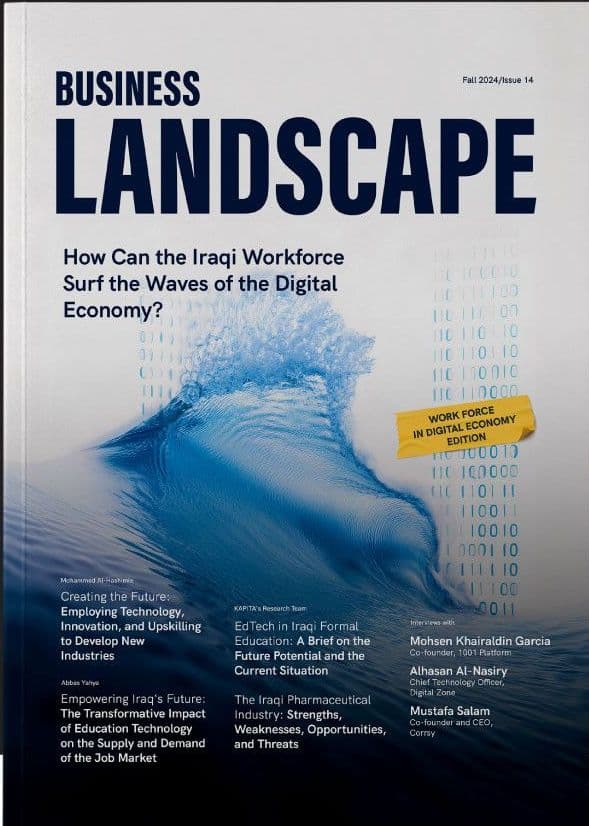
2--Copy-of-BL-XIV-en-cover-4__1920.jpg
14•November 12, 2024

Business LANDSCAPE Magazine Issue 14

#Iraq#Business LANDSCAPE#Digital Economy Iraq#Digital transformation Iraq#Workforce Development in Iraq#EdTech & Digital Education in Iraq#Pharmaceutical Industry in Iraq#Digital Platforms & Social Media in Iraq#Market Research Iraq#Iraq Market Research
November 12, 202412 Articles

Issue Overview

The 14th issue of Business LANDSCAPE Magazine explores the transformative impact of the digital economy on Iraq, with a strong focus on how technology is reshaping the workforce, education, and key industries. This edition examines how Iraqi professionals and businesses can adapt to the demands of a rapidly evolving digital labor market through upskilling, innovation, and lifelong learning. The issue covers critical themes including the role of EdTech in aligning education with labor market needs, financial inclusion as a key enabler of digital economic growth, and the digital transformation of Iraq’s pharmaceutical sector, highlighting both opportunities and structural challenges. It also analyzes the rise of digital platforms, social media marketing, and small digital-first businesses as drivers of entrepreneurship and global market access. Featuring exclusive interviews with leaders from the technology, digital education, media, and entertainment sectors, alongside in-depth research and expert insights, this issue provides a comprehensive perspective on the shifts shaping the future of Iraq’s private sector and digital economy.

Articles in this Issue

Scroll to see all 12 articles

How Can the Iraqi Workforce Surf the Waves of the Digital Economy?

Iraq’s digital shift is redefining employability, with innovation hubs (QAF Lab), EdTech (Abwaab, Ta3leem, Corrsy), social media marketing, micro-startups, fintech inclusion, pharma digitization, and streaming (1001) expanding skills and jobs. The biggest hurdles are brain drain and a mismatch between education and market needs; solving them requires cohesive national policy, corporate investment in tech talent, and a culture of lifelong learning. The payoff is a resilient, future-ready economy powered by adaptable, digitally fluent workers.

ArticleSafwa Salim10 min
Read

Creating the Future: Employing Technology, Innovation, and Upskilling to Develop New Industries

QAF Lab shows how pairing digital innovation with upskilling can create new Iraqi jobs: building VR/AR, software, and media services for niche/global markets while preserving heritage through immersive tech and partnerships. A continuous-learning culture and internship pipeline produce market-ready talent, aiming to scale a resilient, inclusive digital workforce.

ArticleMohammed Al-Hashimie15 min
Read

Empowering Iraq's Future: The Transformative Impact of Education Technology on the Supply and Demand of the Job Market

Abwaab is reshaping Iraq’s education and job market by delivering personalized, accessible online learning at scale—opening pathways for students like Huda while creating new roles (MTAs, academic auditors, advisors), upskilling teachers, and stimulating the wider digital economy. Its flexible, data-driven model is poised to integrate AI and serve as a regional blueprint for equitable, future-ready learning.

ArticleAbbas Yahya15 min
Read

Revolutionizing Reach: The Impact of Social Media on Iraqi Businesses and Marketing Industry

Social media has transformed Iraqi marketing from ad-hoc posts to a professional, agency-driven ecosystem—spawning new creative/data roles, attracting global brands, enabling remote, inclusive work, and fueling community upskilling; Sagerlabs embodies this shift with regional reach, AI-enabled execution, and talent bridge-building, positioning Iraq for an innovation-led, collaborative future.

ArticleAhmed A. Aljazaery -Sarah M. Alkubaisi 20 min
Read

From Niche to Global: How Micro-Startups Can Leverage the Power of Digital Economy

Micro-startups can scale from niche to global by leveraging the digital economy—keep costs low, focus on a specific problem, automate (especially in SaaS), sell directly across borders, and, as Kawenter shows, expand beyond the home market while mitigating funding, talent, and regulatory hurdles by targeting receptive markets and incorporating abroad.

ArticleMustafa Alwan10 min
Read

Empowering Underserved Communities: Catalyzing Financial Inclusion in Iraq’s Digital Economy

Digital wallets, online banking, and data-driven credit are widening affordable finance in Iraq—fueling e-commerce and remittances—though connectivity gaps, low literacy, and privacy risks persist. GIZ’s FI project with the Central Bank has trained 3,000+, supported 5 providers, financed 25 SMEs (Bloom), and advanced digital-credit rules and a national inclusion strategy.

Article Pauline Krebs 10 min
Read

A New Era of Efficiency and Innovation: Digital Transformation in Iraq’s Pharmaceutical Industry

Public moves include the MoH’s web-based company/product registration with debit e-payments and real-time tracking, IPhvC’s 24/7 digital ADR reporting, and KMCA’s QR-based authenticity checks. On the private side, Mercato/Capsula link pharmacies to suppliers, Dofied replaces paper receipts with traceable e-receipts and monitored cash flows, and WenkGPS safeguards cold-chain deliveries. The payoff: speed, transparency, and accuracy across registration, supply chains, and payments. The hurdles: upfront costs, skill gaps, and cultural resistance. With targeted investment, upskilling, and supportive regulation, Iraq can meet global standards, attract FDI, and deliver safer, more reliable medicines nationwide.

ArticleAws A. Hassan 15 min
Read

The Iraqi Pharmaceutical Industry: Strengths, Weaknesses, Opportunities, and Threats

Iraq’s pharma sector counts 23 national manufacturers with some GMP/ISO gains and product/packaging upgrades, yet relies on imported APIs and lacks biologics/WHO-prequalified capacity. Opportunities: tariff relief, procurement reforms, exports, and global partnerships. Threats: regulatory gaps, counterfeits/corruption, low R&D, talent shortages, and economic instability—making regulation, training, and incentives pivotal.

ArticleKAPITA’s Research Team15 min
Read

EdTech in Iraqi Formal Education: A Brief on the Future Potential and the Current Situation

EdTech in Iraq is accelerating post-COVID, which pushed 9M+ students online and exposed shortages in teachers, infrastructure, and digital skills. With platforms like Eduba, Sadeem, Newton, Ta3leem, and Abwaab, a hybrid model can personalize learning and streamline schools—if policies modernize, LMSs roll out, and access/training gaps are funded.

ArticleKAPITA’s Research Team20 min
Read

Business Landscape Interview

In this interview, Mr. Salam shares his journey of entrepreneurship and innovation within Iraq's education sector. He delves into how the Finnish educational experience has shaped the development of the Corrsy platform and its broader impact on Iraqi education. He also discusses the challenges faced in the education sector, such as the delivery of quality education, costs, learning outcomes, and the lack of collaboration. Furthermore, Mr. Salam offers insights into the Iraqi ecosystem and the investment landscape and concludes with Corrsy's future plans.

ArticleMustafa Salam20 min
Read

Business Landscape Interview

In this interview, Mr. Al-Nasiry provides insightful reflections on Iraq’s tech landscape and tech talent. He emphasizes the importance of aligning the education system with market demands, identifying gaps in talent development, and addressing the pressing issue of brain drain in the tech sector. He offers his perspective on the impact of current digital transformation initiatives and the prospects for job creation over the near future.

ArticleAlhasan Al-Nasiry20 min
Read

Business Landscape Interview

In this interview, Mr. Khairaldin shares with us insights on Iraq's entertainment sector and the development of Iraqi consumer behavior towards streaming services. He discusses the challenges and opportunities within the entertainment industry, addressing topics such as infrastructure, online content piracy, regulations, and more. Additionally, he highlights the 1001 platform’s contribution to local production and job creation, as well as the role of local and regional partnerships in 1001's growth. He also explores cultural factors influencing entertainment consumption in Iraq and emerging trends shaping the sector’s future.

ArticleMohsen Khairaldin Garcia20 min
Read

Issue Information

Available Documents

1 document available for download

Click any document to download. Email verification may be required.

Subscribe to Magazine

Details

  • Issue:14
  • Published:November 12, 2024
  • Articles:12 Articles
  • Tags:10
  • Attachments:1 PDF

Need Custom Analysis?

Contact our research team to discuss your specific business landscape analysis needs.

Contact Us
Related Issues
BLM 16
16Oct 2025

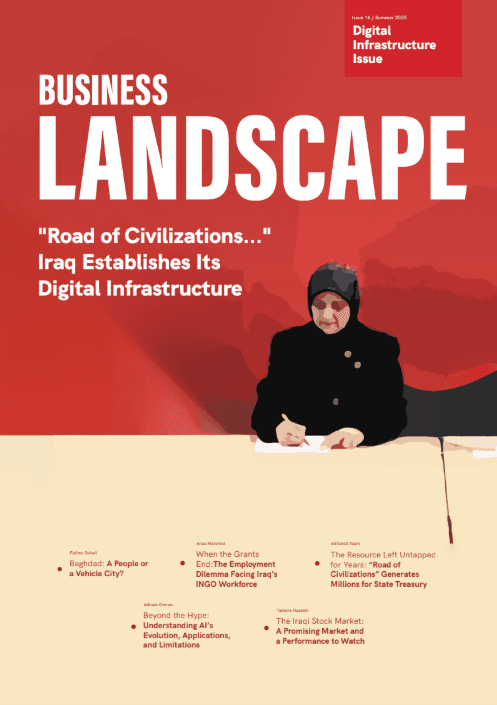
Business LANDSCAPE Magazine Issue 16

We are delighted to present the sixteenth issue of Iraq Business Scene magazine – the Digital Infrastructure Edition –...

#ICT Iraq+12
Read Issue
blm 16 cover page
16Oct 2025

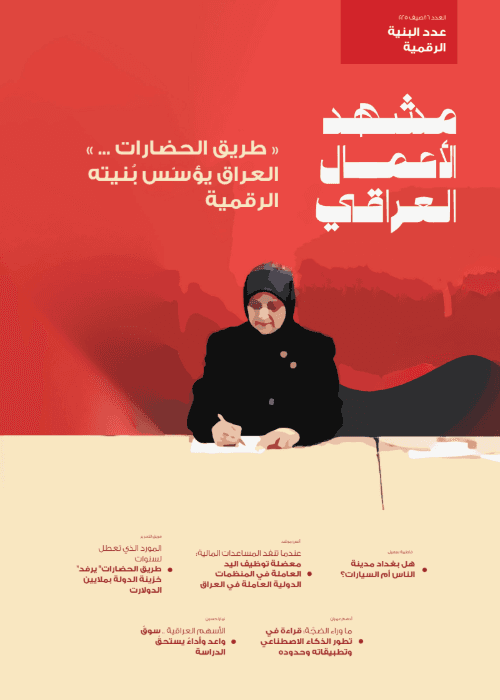
مشهد الأعمال العراقي 16 (اصدار البنية الرقمية)

يسعدنا أن نقدم لكم العدد السادس عشر من مجلة مشهد الأعمال العراقي – عدد البنية الرقمية – الذي يقدم استكشافًا معمقًا لنهضة...

#العراق+10
Read Issue
banner 15 en cover__2837.jpg
15Jan 2025

Business LANDSCAPE Magazine Issue 15

We are pleased to present the 15th edition of Business LANDSCAPE Magazine, offering an in-depth exploration of Iraq's...

#Iraq Market Research+10
Read Issue